How to Choose a Automotive Wireless Charger : Vehicle Fit, Input Voltage and Installation
Choosing a automotive wireless charger is not only about comparing 15W, 20W, or higher charging power. In a real vehicle, input voltage, installation space, phone compatibility, coil position, temperature, wiring, and mounting structure can all affect charging performance.
At DAMAVO®, we recommend starting with the vehicle and installation conditions before selecting an automotive wireless charger. This makes it easier to choose a suitable solution and can also reduce later changes to the housing, wiring, connectors, or mounting structure.
Quick Answer: How Do You Choose a Automotive Wireless Charger?
To choose the right automotive wireless charger, first check your vehicle voltage, installation space, phone compatibility, wireless charging standard, and installation method.
For integrated vehicle applications, you should also consider coil alignment, thermal performance, wiring, connectors, and safety protection.
Before selecting a charger, confirm these five points:
- Is the vehicle electrical system 12V or 24V?
- What Qi or Qi2 charging standard do the target phones require?
- Where will the charger be installed?
- How much installation space is available?
- Are custom wiring, connectors, or mounting structures required?
These basic questions can help narrow down the right solution before you compare charging power or product appearance.
1. Start With Vehicle Fit and Installation Space
A automotive wireless charger has to work inside a real vehicle interior. Because of this, installation space is often one of the first things you should check.
 Center consoles, dashboards, armrests, storage compartments, and other interior panels can vary greatly between vehicle models. A charger that works well in one vehicle may not fit another without structural changes.
Where Will the Automotive Wireless Charger Be Installed?
Common installation locations include:
- Center consoles
- Dashboards
- Armrests
- Storage compartments
- Interior trim panels
Once the installation position is clear, measure the available space.
We normally recommend checking:
- Available length and width
- Installation depth
- Panel thickness
- Space behind the panel
- Phone placement area
- Space for wiring and connectors
For a built-in wireless car charger, the visible front dimensions are only part of the installation.
You also need enough space behind the panel for the wireless charging module, wiring harness, connector, and fixing structure.
Built-In or Surface-Mounted?
If the wireless charger needs to become part of the original vehicle interior, a built-in design can provide a cleaner and more integrated appearance.
For existing vehicles, aftermarket upgrades, or retrofit projects, a surface-mounted or bracket-mounted solution may be easier to install.
At DAMAVO®, we normally do not decide which option is better without first understanding the vehicle structure.
The suitable design depends on available space, interior design, assembly method, and maintenance requirements.
2. Check the Vehicle Input Voltage
A wireless car charger does not directly send vehicle voltage to the smartphone.
The vehicle DC supply first passes through internal power regulation. The wireless charging module then transfers energy to the phone.
Because of this, input voltage is one of the basic specifications that should be confirmed before selecting the charger.
For vehicle projects requiring different charging options, DAMAVO provides a range of vehicle charger solutions for different electrical systems and installation requirements.
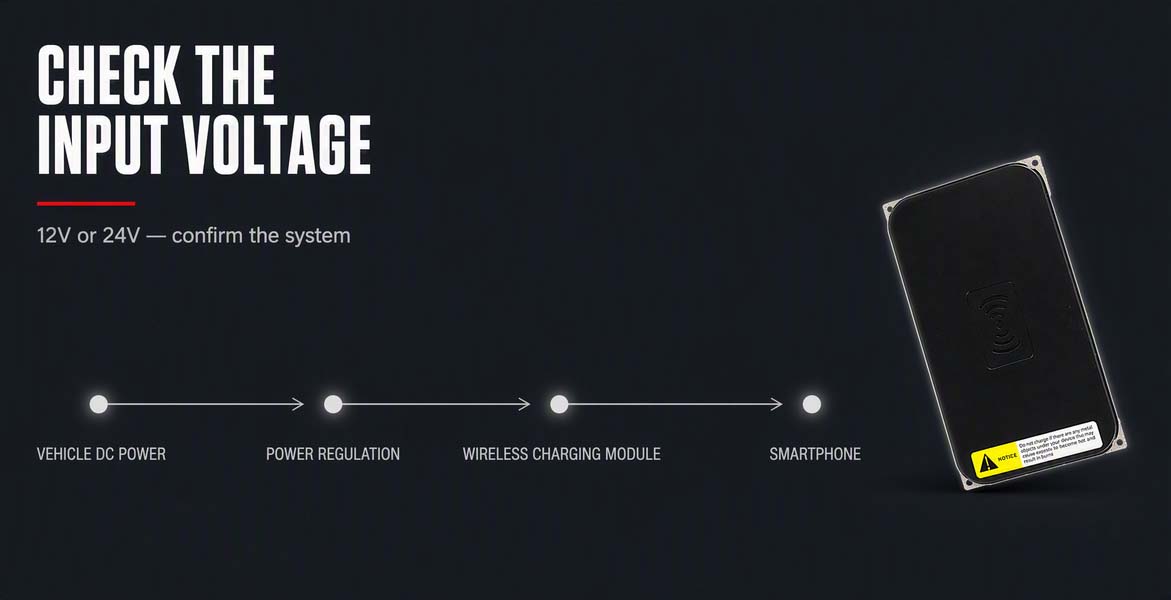
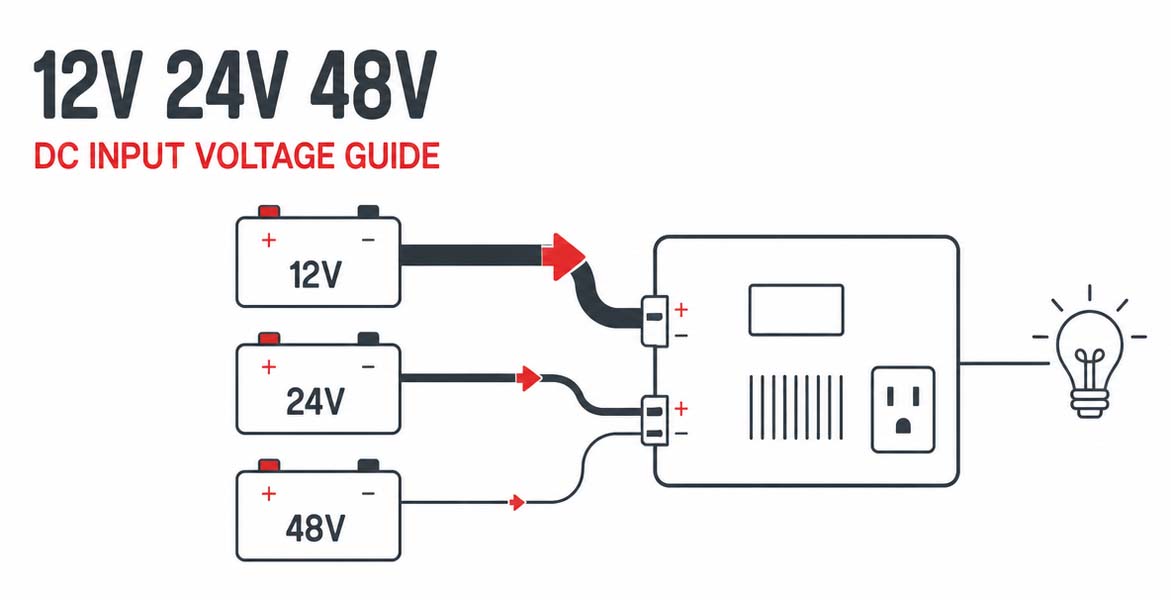
12V or 24V Vehicle?
Many passenger cars and some RV applications use 12V electrical systems.
24V systems are also commonly used in trucks, buses, and some commercial vehicles.
However, vehicle type alone should not be used to determine the voltage.
If you are developing a specific vehicle project, always confirm the actual operating voltage and expected voltage range of the electrical system.
Why Does the Input Voltage Range Matter?
Vehicle voltage is not always completely stable.
If a wireless charger supports only a narrow input range, its performance may be affected when the vehicle voltage changes outside that range.
For projects covering several vehicle platforms, a wider input voltage range may also reduce the number of different charger models required.
The power path can be understood simply as:
Vehicle DC Power → Power Regulation → Wireless Charging Module → Smartphone
In most projects, it is better to confirm the vehicle-side electrical requirements first and then decide on wireless charging output.
3. Check Phone, Qi and Qi2 Compatibility
Once the vehicle power requirements are clear, the next step is checking whether the target phones can charge reliably.
It is not enough to know that a phone supports wireless charging.
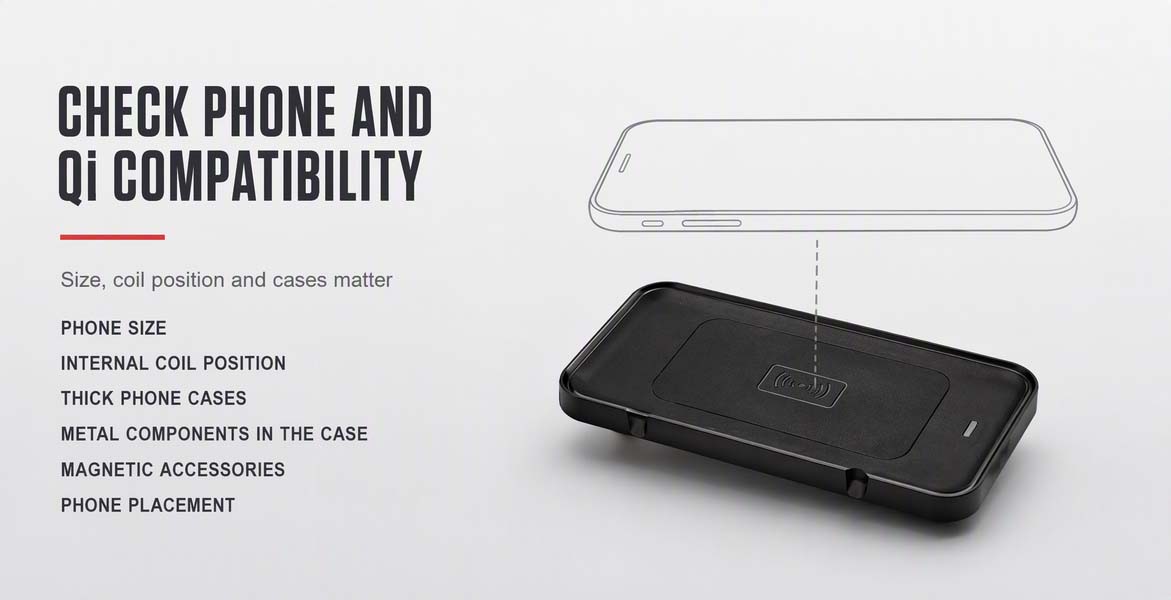
Different devices may use different charging standards, coil positions, phone sizes, cases, and thermal control strategies.
Qi and Qi2 Compatibility
Qi is one of the most widely used wireless charging standards.
Qi2 adds improved magnetic alignment and positioning for compatible devices.
For a broader overview of DAMAVO's wireless charger solutions, you can also explore the wireless charger series.
If you are developing a new vehicle platform, we recommend confirming which wireless charging standard your target phones require before selecting the charging module.
This helps reduce the risk of completing the mechanical design first and later finding that some target phones cannot achieve the expected charging performance.
Phone Size and Phone Cases Also Matter
Even when two phones both support wireless charging, their actual performance may be different.
Several factors can affect charging:
- Phone size
- Internal coil position
- Thick phone cases
- Metal components in the case
- Magnetic accessories
- Phone placement
This is why the charging area should help keep the phone in a stable position.
A well-designed tray, positioning structure, phone stop, or magnetic alignment system can help keep the phone coil closer to the charger coil.
4. Do Not Choose a Wireless Charger by Wattage Alone
15W, 20W, or higher charging power is easy to compare on a specification sheet.
However, maximum rated power is only one part of the actual charging experience.
In real vehicle applications, charging performance can also depend on:
- Vehicle power supply
- Phone charging protocol
- Coil alignment
- Battery level
- Phone temperature
- Charger temperature
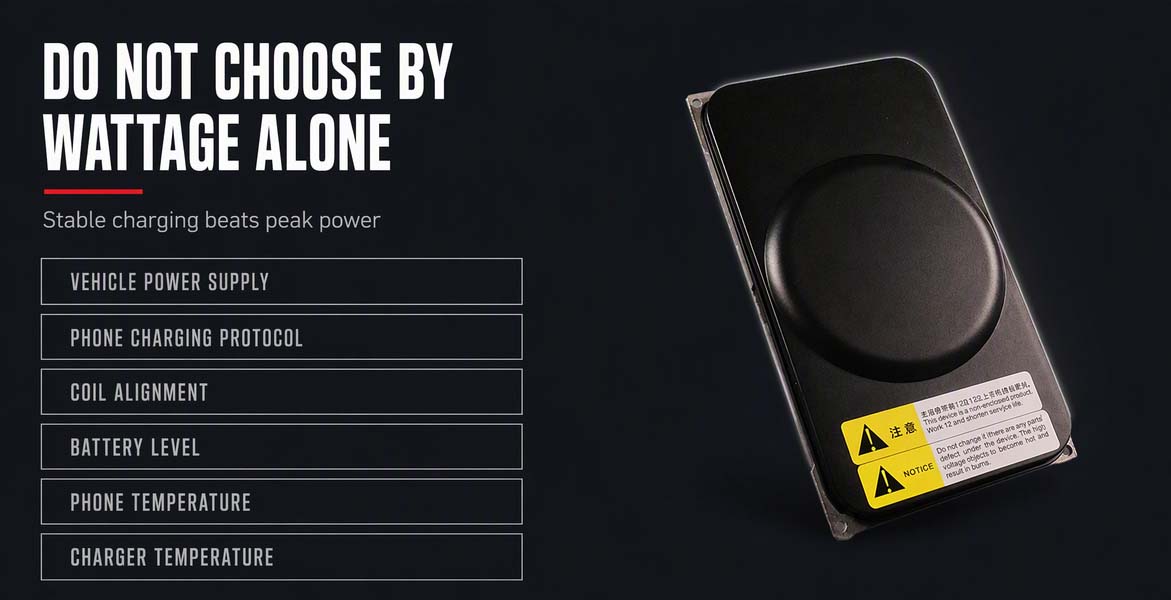
A phone does not necessarily receive the maximum rated charging power during the entire charging process.
Charging power may change depending on battery level, temperature, charging protocol, and system conditions.
For example, a charger may support a high peak charging level, but the phone may reduce charging power as the battery becomes fuller or the temperature increases.
So instead of asking only:
“What is the maximum charging power?”
It is also useful to ask:
“Can the charger maintain stable charging in the intended vehicle environment?”
For many vehicle projects, consistent charging performance is more useful than reaching maximum power for only a short period.
5. Consider Coil Alignment and Thermal Performance
Wireless charging transfers energy between the transmitter coil inside the charger and the receiver coil inside the smartphone.
For efficient charging, these two coils need to remain reasonably aligned.
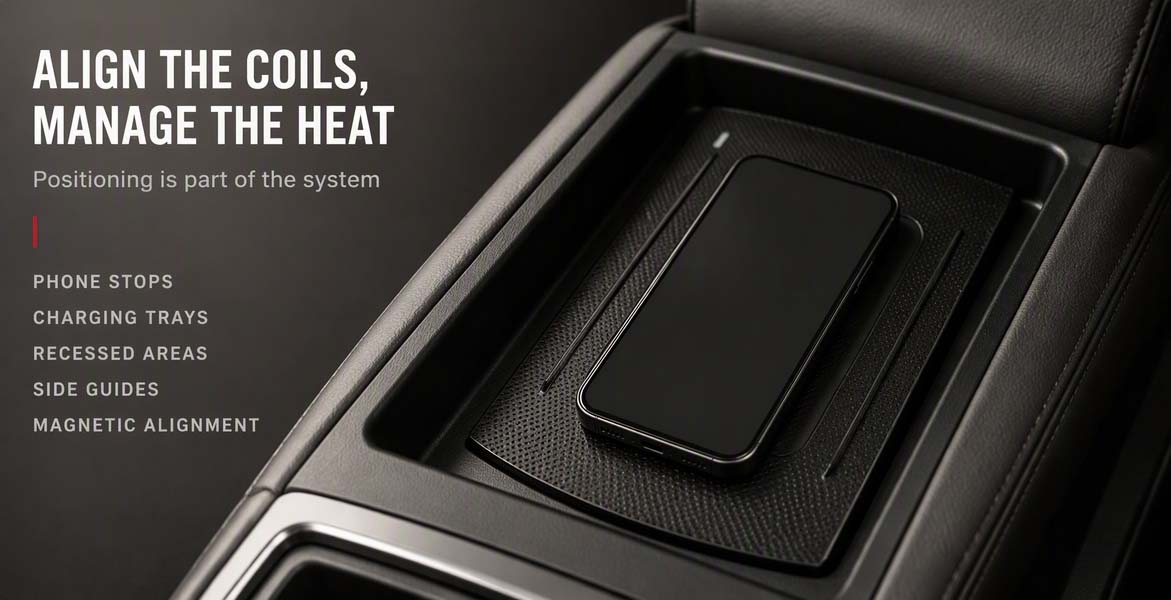
If the coils are significantly misaligned, energy transfer efficiency may decrease. The system may also generate more heat.
This means the phone storage area is not only an interior design feature. It is also part of the wireless charging system.
Why Is Coil Alignment Important?
Several mechanical features can help improve phone positioning:
- Phone stops
- Charging trays
- Recessed areas
- Side guides
- Magnetic alignment structures
The goal is not simply to prevent the phone from moving.
The structure should help position the phone where the charging coils can work efficiently.
Why Does Temperature Matter in a Vehicle?
A wireless charger inside a vehicle operates in a different environment from a charger on an office desk.
A parked vehicle can become very hot in summer.
At the same time, the phone may be running:
- Navigation
- Music
- Bluetooth
- Mobile data
- Other applications
These conditions can increase temperature while the phone is charging.
Wireless charging itself also produces some heat.
When the temperature becomes too high, the phone or charging system may automatically reduce charging power.
When we evaluate a vehicle wireless charging project, we therefore look at factors such as:
- Installation position
- Surrounding ventilation space
- Temperature rise during continuous operation
- Charging stability at higher temperatures
- Heat generated by poor coil alignment
For long-term vehicle use, stable thermal performance is usually more important than a short peak-power result.
6. Check Safety and Protection Features
A automotive wireless charger becomes part of the vehicle electrical system, so safety protection should be considered during product selection.
Useful protection functions can include:
- Foreign Object Detection (FOD)
- Over-voltage protection
- Over-current protection
- Over-temperature protection
- Short-circuit protection
Keys, coins, and other metal objects can sometimes be placed inside a vehicle storage compartment together with the phone.
Foreign Object Detection helps the charging system identify abnormal metal objects in the charging area.
When an abnormal condition is detected, the system can reduce or stop charging.
This helps reduce unnecessary heating and improves the safety of the charging area.
Safety protection should therefore be evaluated together with charging performance rather than treated as an additional feature.
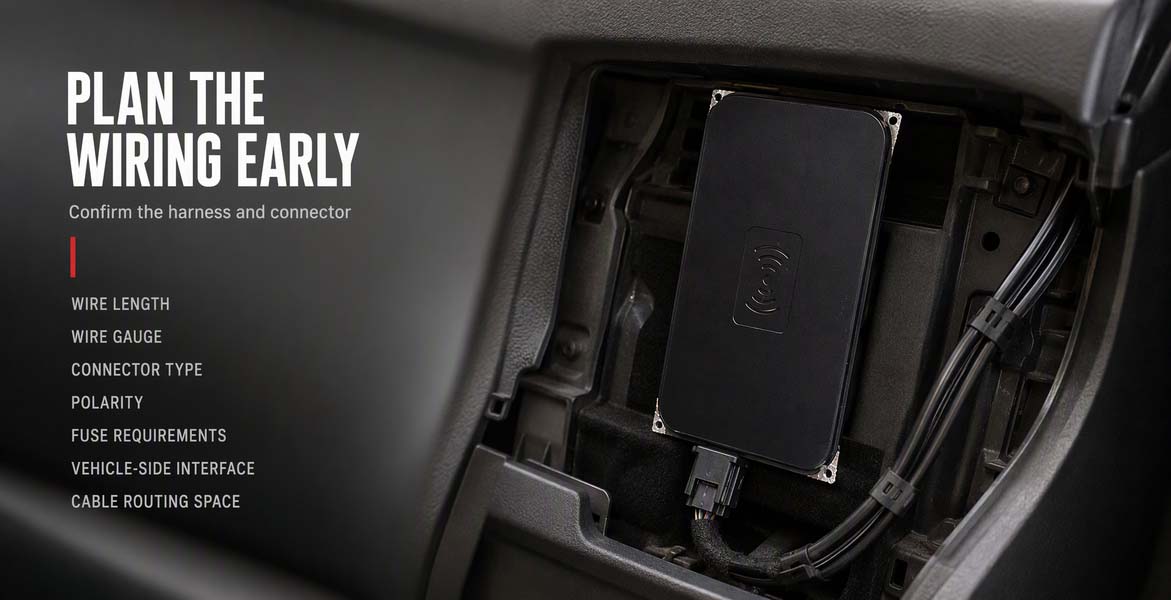
7. Plan Wiring and Electrical Integration Early
If the wireless charger will be integrated into a vehicle, we recommend confirming the electrical connection early in the project.
Waiting until the housing or interior panel design is already finished can create unnecessary changes later.
Confirm the Wiring Harness and Connector
Useful information includes:
- Wire length
- Wire gauge
- Connector type
- Polarity
- Fuse requirements
- Vehicle-side interface
- Cable routing space
If the vehicle already uses a specified connector, it is often better for the wireless charger to match the existing interface instead of adding an extra adapter.
For projects that require both wired and wireless charging, you can also compare DAMAVO's USB charger solutions.
This can simplify vehicle assembly and reduce unnecessary connection points.
Think About Assembly and Maintenance
Electrical design should also consider how the charger will be assembled and serviced.
For example, ask:
- Can the connector be reached during assembly?
- Is there enough room for cable routing?
- Can the charger be removed for maintenance?
- Does the wiring interfere with surrounding components?
These details may appear small at the beginning of a project, but they can have a large effect on production and installation later.
8. Prepare Your Project Requirements Before Selection
If you are looking for an existing automotive wireless charger or considering a customized solution, the project usually moves faster when the basic requirements are clear.
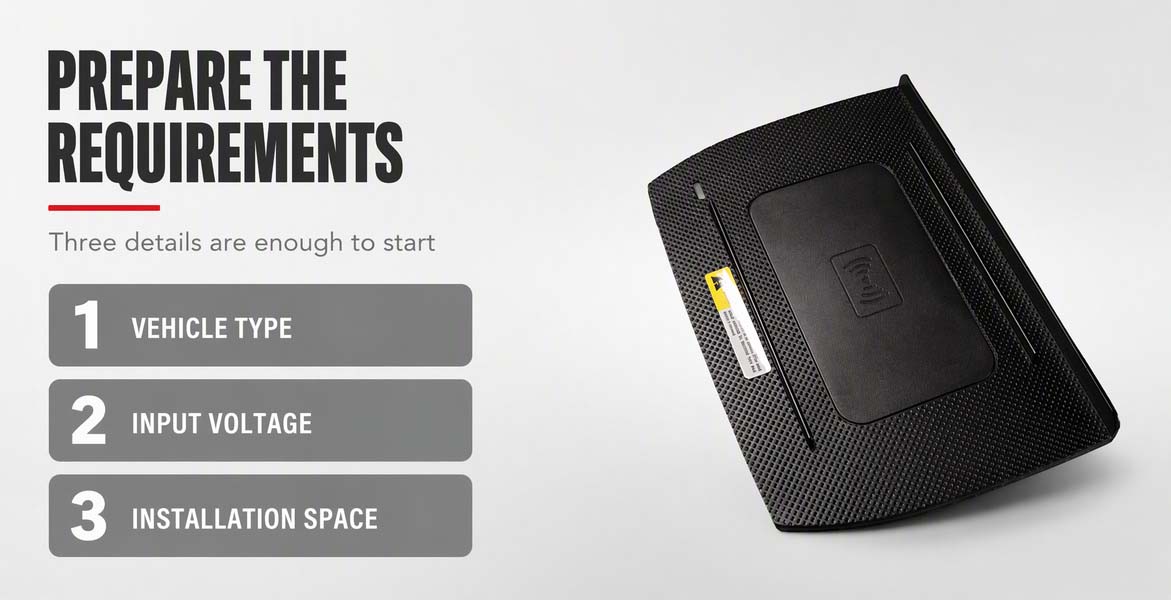
At DAMAVO®, these are some of the first details we normally review:
- Vehicle type
- Input voltage
- Required wireless charging power
- Wireless charging standard
- Installation location
- Available installation dimensions
- Target phones or devices
- Wiring and connector requirements
- Operating environment
- Certification requirements
- Estimated order quantity
You do not always need to have every specification ready at the beginning.
In many cases, three pieces of information are enough for an initial evaluation:
Vehicle type, input voltage, and installation space.
Once these are clear, we can start evaluating whether an existing solution is suitable or whether the mechanical or electrical structure needs to be adjusted.
How Can DAMAVO® Support Wireless Car Charger Projects?
Different vehicle platforms do not always require the same wireless charging solution.
DAMAVO® supports wireless charging applications for vehicle interiors such as:
- Passenger cars
- SUVs
- RVs
- Trucks
- Buses
- Other vehicle platforms
Depending on the project, we can work with customers on:
- Product dimensions
- Housing structure
- Mounting design
- Wiring harness length
- Connector matching
- Wireless charging specifications
- Branding and logo requirements
- Project-specific structural adjustments
If you already have vehicle interior drawings, installation dimensions, connector information, or electrical interface requirements, these can be provided during the early project stage.
Our engineering team can then evaluate whether an existing DAMAVO® automotive wireless charger is suitable or whether a customized solution is required.
A suitable wireless car charger should do more than simply charge a phone when it is placed on the pad.
It should fit naturally into the vehicle interior, connect correctly to the electrical system, keep the phone properly positioned, and provide stable charging under real operating conditions.
Frequently Asked Questions

Q1: What Input Voltage Does a Wireless Car Charger Use?
A1: The required input voltage depends on the charger design and the vehicle electrical system.
Before choosing a wireless car charger, confirm the actual vehicle voltage and then check whether the charger's specified input range is suitable.
Q2: Can a Wireless Car Charger Work in Both 12V and 24V Vehicles?
A2: Some wireless chargers with a wider input voltage range can support both 12V and 24V vehicle applications.
However, this is not true for every charger. Always check the specified input voltage range before integrating the product into the vehicle electrical system.
Q3:Is a Higher-Power Wireless Car Charger Always Better?
A3: Not necessarily. Actual wireless charging performance also depends on phone compatibility, input power, coil alignment, battery condition, and temperature. Stable charging performance can be more important than simply selecting the highest rated wattage.
Q4: Does a Phone Case Affect Wireless Charging?
A4: Yes, it can. A very thick phone case, metal components, or some magnetic accessories may affect the distance and alignment between the phone coil and charger coil. This may reduce charging efficiency or prevent charging in some situations.
Q5: Why Does a Wireless Car Charger Get Hot?
A5: Some heat is normal during wireless charging. Higher temperatures may occur when the phone and charger coils are poorly aligned, the vehicle interior is already hot, or the phone is running demanding applications while charging. Good mechanical positioning and thermal design can help improve charging stability.
Q6: Why Does Coil Alignment Matter for a Wireless Car Charger?
A6: Wireless charging depends on energy transfer between the transmitter coil in the charger and the receiver coil inside the phone. Better alignment can improve charging efficiency. Significant misalignment may reduce power transfer and increase heat.
Q7: What Information Should I Provide for a Custom Wireless Car Charger Project?
A7: For an initial evaluation, you can usually start with:
- Vehicle type
- Input voltage
- Installation location
- Available dimensions
- Required charging power
- Target phone models or charging standard
If available, you can also provide drawings, connector specifications, wiring requirements, and vehicle interface information.
Q8: Can DAMAVO® Customize a Wireless Car Charger for a Vehicle Project?
A8: Yes. DAMAVO® can support adjustments to the product structure, mounting method, wiring harness, connector, housing, branding, and selected wireless charging specifications based on project requirements.
Providing the vehicle type, input voltage, and installation dimensions is usually a good starting point for project evaluation.
How to Choose a 12V/24V USB Charger with USB-C PD
Power Inverter Manufacturer Guide: How OEM Buyers Should Evaluate an Inverter Supplier
Related Article