How to Choose a 12V/24V USB Charger with USB-C PD
Choosing the right 12V or 24V USB-C car charger starts with the vehicle electrical system, required charging power, port configuration, and installation space. For trucks, RVs, buses, or equipment, wide-input USB charging can also simplify integration across different platforms.
- Check input voltage: 12V, 24V, or wide input
- Match charging power to the device
- Compare single-port and total output
- Confirm USB-C, PD, and PPS support
- Check mounting space and operating environment
12V vs 24V USB Chargers
The first step is to match the charger to the vehicle electrical system.
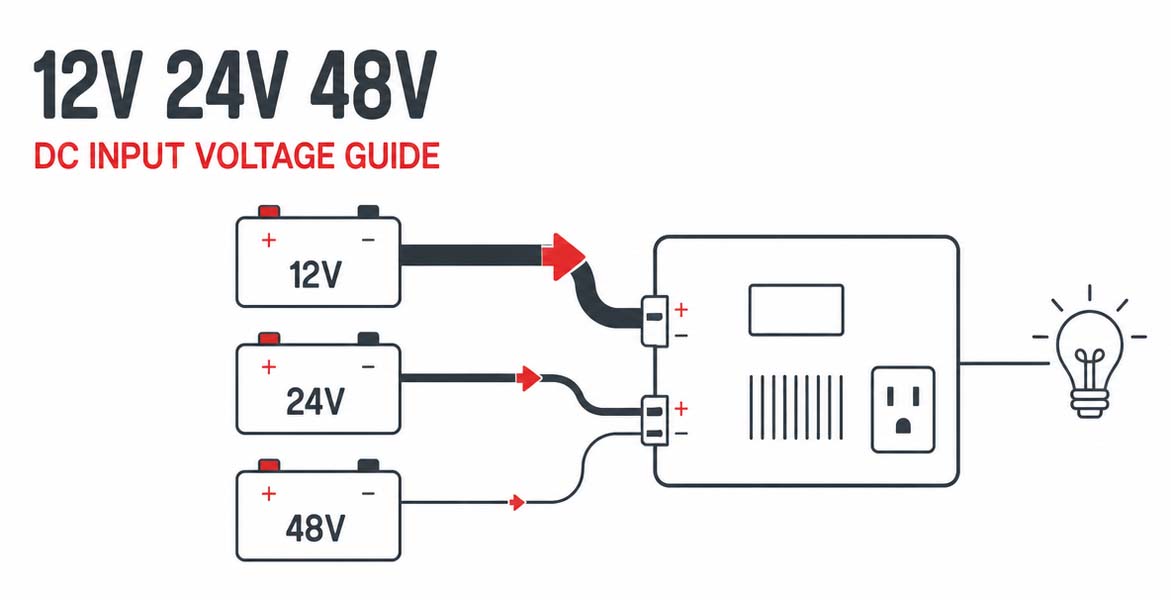
A 12V car charger is commonly used in passenger cars, vans, RVs, and similar platforms. A 24V vehicle charger is more common in trucks, buses, construction machinery, and agricultural equipment.
 The key specification is the actual input voltage range, not only the nominal label.
When Is Wide Input Useful?
A wide-input design such as 9–36V can support both 12V and 24V systems.
This is useful when one charger needs to be used across several vehicle platforms because it can reduce the number of models required.
USB-A, USB-C, or Both?
USB-A is still useful for older cables and devices, while USB-C is better suited to newer phones, tablets, laptops, and higher-power charging.
For mixed-use applications, USB-A + USB-C is a practical option. For newer platforms, dual USB-C may be more suitable.
 If you want to compare different port layouts and power levels, explore our automotive USB chargers for cars, trucks, RVs, and equipment.
What Does USB-C PD Change?
USB Power Delivery allows the charger and connected device to negotiate a suitable power level.
Depending on the application, the charger may support 5V, 9V, 12V, 15V, or 20V outputs.
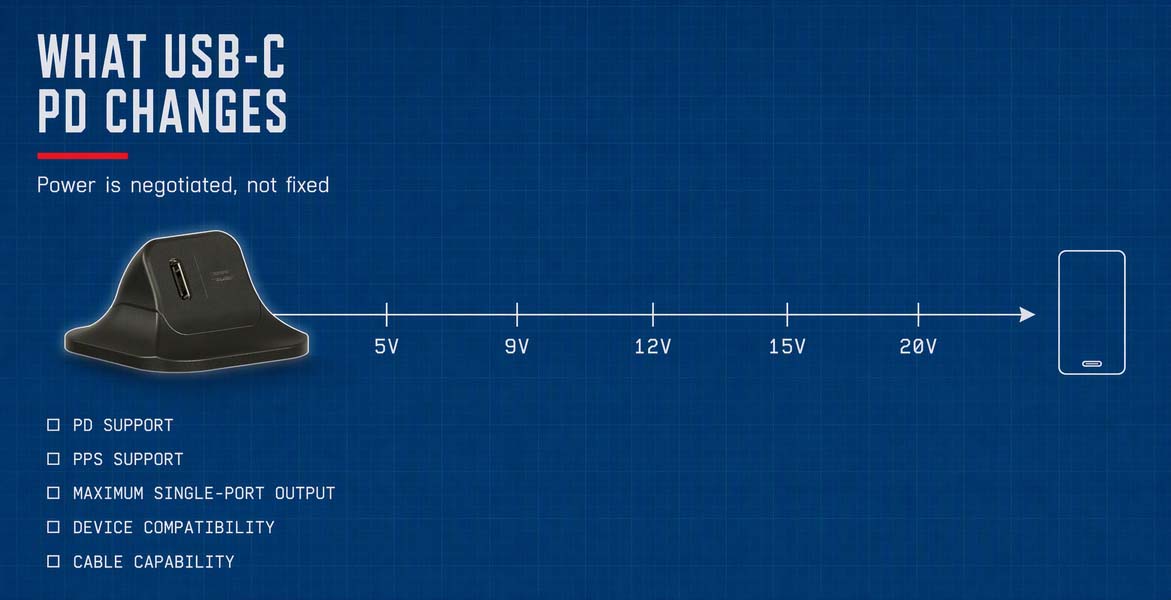
When selecting a USB C car charger, confirm:
- PD support
- PPS support if required
- Maximum single-port output
- Device compatibility
- Cable capability
How Much Charging Power Do You Need?
The correct power level depends on the device.
| Device |
|
| Smartphone | 20W–30W |
| Tablet | 30W–45W |
| Laptop / high-power device | 45W, 65W, or higher |
For multi-port chargers, always check both single-port output and total output.
A dual USB-C charger rated at 120W may distribute power as 60W + 60W or 100W + 20W. The right configuration depends on what devices will be connected at the same time.
For laptop charging or other higher-power applications, a high-power USB-C car charger with PD 3.1 may be more suitable.
What Should You Check Before Selection?
Electrical performance is only part of the decision.
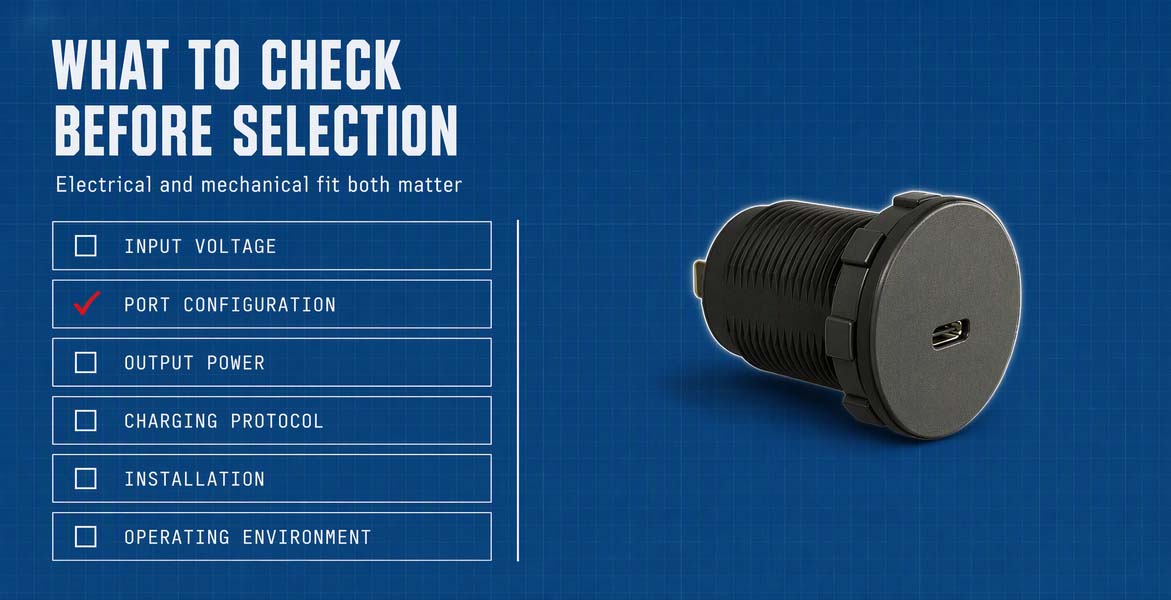
A charger also needs to fit the vehicle mechanically and operate reliably in the intended environment.
1. Input Voltage
Confirm the charger supports the actual vehicle operating range.
2. Port Configuration
Choose USB-A, USB-C, A+C, or C+C based on the devices being charged.
3. Output Power
Check per-port power, total output, and power distribution.
4. Charging Protocol
Confirm PD, PPS, or any other required protocol.
5. Installation
Check panel cutout, installation depth, connector direction, and wiring space.
6. Operating Environment
For RVs, boats, construction equipment, or agricultural vehicles, consider water, dust, vibration, and temperature.
USB Charger Selection by Application
Different platforms have different priorities.
| Application |
|
| Passenger Car | 12V, compact size, USB-C PD |
| Truck / Bus | 24V or wide input, multi-port charging |
| RV / Camper | Multi-device use, mounting, protection |
| Construction / Agricultural Equipment | Wide input, vibration, dust |
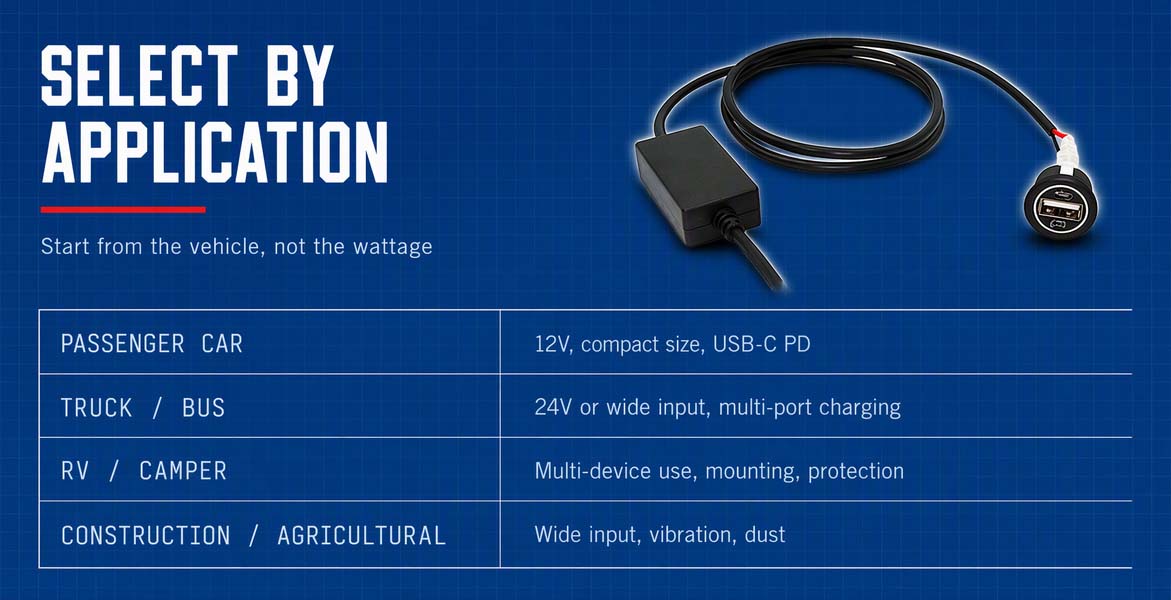
This is why charger selection should start from the vehicle application rather than wattage alone.
What Information Should Be Confirmed Before a Project?
A complete specification is not always needed at the beginning.
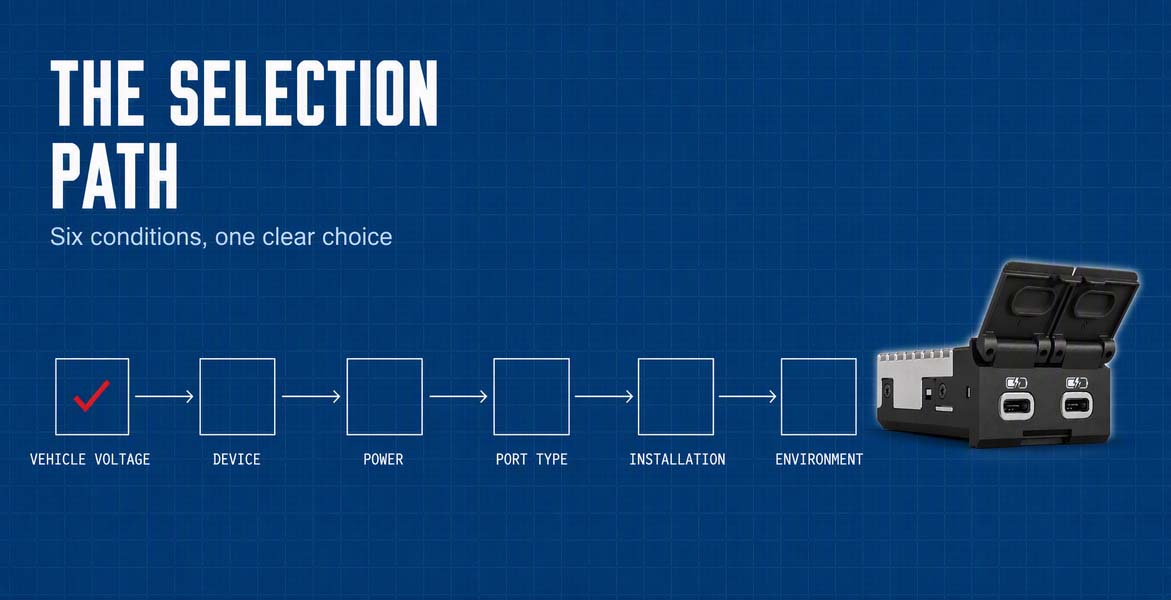
For an initial evaluation, these points are usually enough:
- Vehicle voltage
- Required power
- Port configuration
- Installation size
- Connector and wiring
- Operating environment
Once these are clear, the remaining details can be defined around the actual vehicle platform.
DAMAVO® USB Charging Solutions
DAMAVO® provides USB charger solutions for cars, trucks, RVs, boats, and equipment.
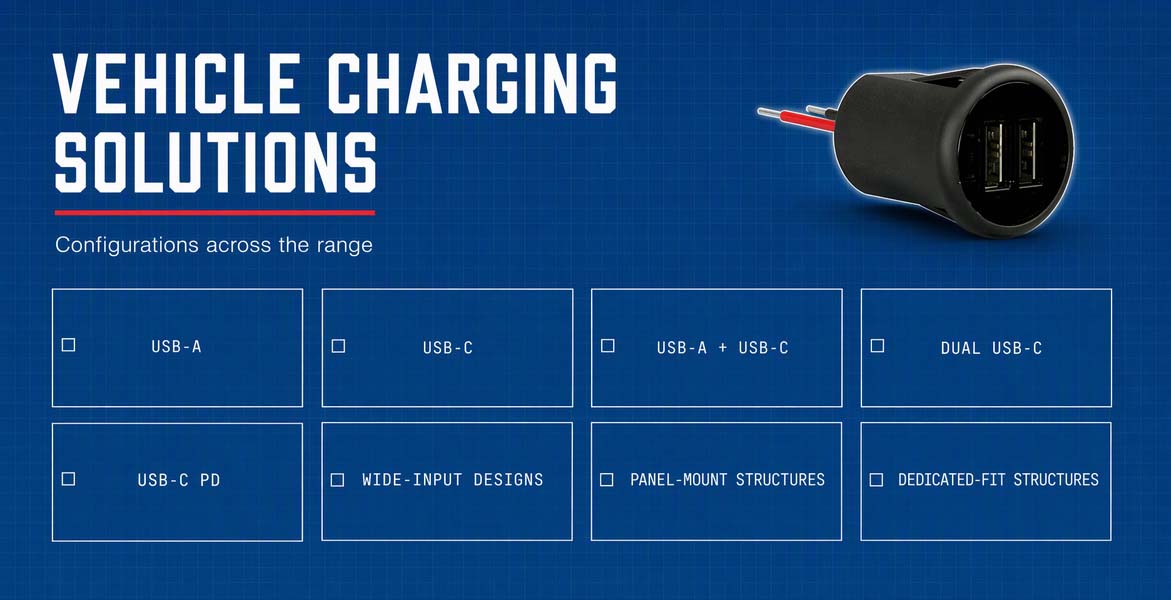
Available configurations can include:
- USB-A
- USB-C
- USB-A + USB-C
- Dual USB-C
- USB-C PD
- Wide-input designs
- Panel-mount and dedicated-fit structures
For projects that cannot use a standard model, specifications such as input range, output power, housing, connector, wiring harness, custom USB charger PCBA , and environmental protection can be adjusted according to application requirements.
If you already know the vehicle voltage, required power, and installation space, you can discuss your charging project with DAMAVO®.
Looking for a vehicle charger for a new project?
Send us the vehicle voltage, required power, port type, and installation space to start product selection.
USB Charger FAQ
Q1: Can a 12V car charger be used in a 24V vehicle?
A1: Only if the charger's specified input range includes 24V. For example, a 9–36V wide-input model can usually cover both 12V and 24V systems, while a 12V-only charger should not be connected directly to a 24V supply. What to check: look at the full input voltage range on the datasheet, not only the product name.
Q2: Should I choose a 12V/24V wide-input charger instead of separate models?
A2: It can be a good choice when the same charger will be used across several vehicle platforms. A wide-input design can simplify product selection and reduce the number of charger versions that need to be managed.
However, input range is only one factor. Output power, thermal performance, installation space, and the vehicle environment still need to match the application.
Q3: Is USB-C always faster than USB-A?
A3: No. USB-C describes the connector, not the actual charging speed. Charging performance depends on the supported protocol, charger output, cable, and connected device. For faster charging, check the protocol and wattage rather than the connector alone.
Q4: How do I choose between 30W, 60W, and 100W+ USB-C charging?
A4: Start with the highest-power device you expect to connect. A phone may only need around 20W–30W, while tablets and laptops often require more. If two devices will charge at the same time, also check how the total power is shared between ports.
Q5: Can a vehicle USB-C charger charge a laptop?
A5: Yes, if the charger, cable, and laptop all support the required USB-C PD power level. For laptop applications, check the device's actual PD requirement before selecting the charger. A lower-power charger may still work, but charging can be slower or insufficient under heavy use.
Q6: What is more important: single-port power or total output?
A6: Both matter. Single-port power tells you the maximum available from one USB port. Total output tells you how much power the charger can supply across all active ports. For a dual-port charger, always check the power distribution when both ports are in use.
Q7: Can DAMAVO® customize a USB charger for a specific project?
A7: Yes. DAMAVO® can support project-based adjustments such as input voltage range, USB-A or USB-C configuration, output power, mounting structure, housing, connector, wiring harness, PCBA, and environmental protection.
For a new project, it is usually helpful to start with the vehicle voltage, required power, available installation space, and target application.
Q8: What information should I send DAMAVO® to evaluate a vehicle charger project?
A8: A complete specification is not required at the beginning.
You can start by providing:
- Vehicle voltage and input range
- Devices to be charged
- Required power
- Port configuration
- Installation space
- Connector or wiring preference
- Operating environment
With these details, DAMAVO® can help determine whether an existing charger is suitable or whether a customized solution should be considered.
Conclusion
A practical vehicle charger selection process is:
Vehicle Voltage → Device → Power → Port Type → Installation → Environment
Once these conditions are clear, it becomes easier to choose between a 12V car charger, 24V vehicle charger, or USB-C PD solution.
At DAMAVO®, USB charger selection is based on the actual vehicle platform and application requirements, not only the maximum wattage listed on a specification sheet.
How to Choose a Automotive Wireless Charger : Vehicle Fit, Input Voltage and Installation
Related Article