12V vs 24V vs 48V Power Inverter: How to Choose the Right DC Input Voltage
Choosing between a 12V, 24V, and 48V power inverter starts with your battery system and power demand. A 12V inverter is often practical for smaller vehicle systems. A 24V inverter can reduce DC current for medium-power applications, while 48V becomes more useful as inverter power increases.
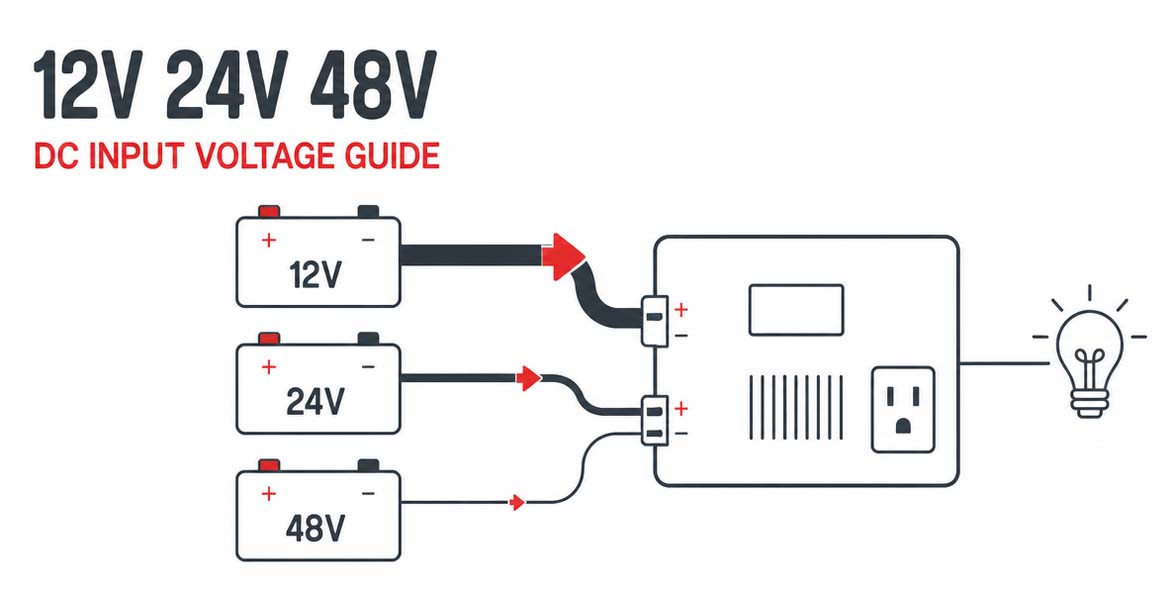
The key point is simple: for the same power, a higher DC voltage requires less current. However, higher voltage is not always better. Your inverter input voltage should match your battery system, wiring, charging system, connected equipment, and future power needs.
Key Takeaways:
- Match the inverter DC input voltage to your battery system.
- Higher DC voltage means lower current for the same power.
- 12V is practical for many smaller vehicle and mobile systems.
- 24V offers a useful balance between power and current.
- 48V is often easier to manage in higher-power systems.
12V vs 24V vs 48V Power Inverter: Quick Comparison
If you only want a quick answer, start with your existing battery voltage and expected AC power demand. The main difference between 12V, 24V, and 48V is not whether they can produce AC power. It is how much current the DC side must carry to provide that power.
| Factor | 12V Power Inverter | 24V Power Inverter | 48V Power Inverter |
| Common system size | Small | Medium | Medium to large |
| DC current at the same power | Highest | Medium | Lowest |
| High-power wiring demand | Higher | Easier to manage | Better for high power |
| Common applications | RVs, vans, vehicles | Trucks, larger RVs, machinery | High-power equipment, off-grid systems |
| Main advantage | Simple and widely used | Good balance of power and current | Lower current at high power |
If your vehicle or battery system is already 12V and your AC load is moderate, there may be no reason to change to 24V or 48V.
As power demand increases, however, DC current becomes more important. This is when a higher system voltage may make the design easier to manage.
Once you know your battery voltage and expected load, you can compare the DAMAVO® power inverter range by DC input voltage and output power.
Why Does DC Input Voltage Matter?
A power inverter takes DC power from a battery system and converts it into AC power for your equipment. Because of this, the DC input voltage directly affects how much current must flow through the battery cables, connectors, fuses, and other parts of the system.
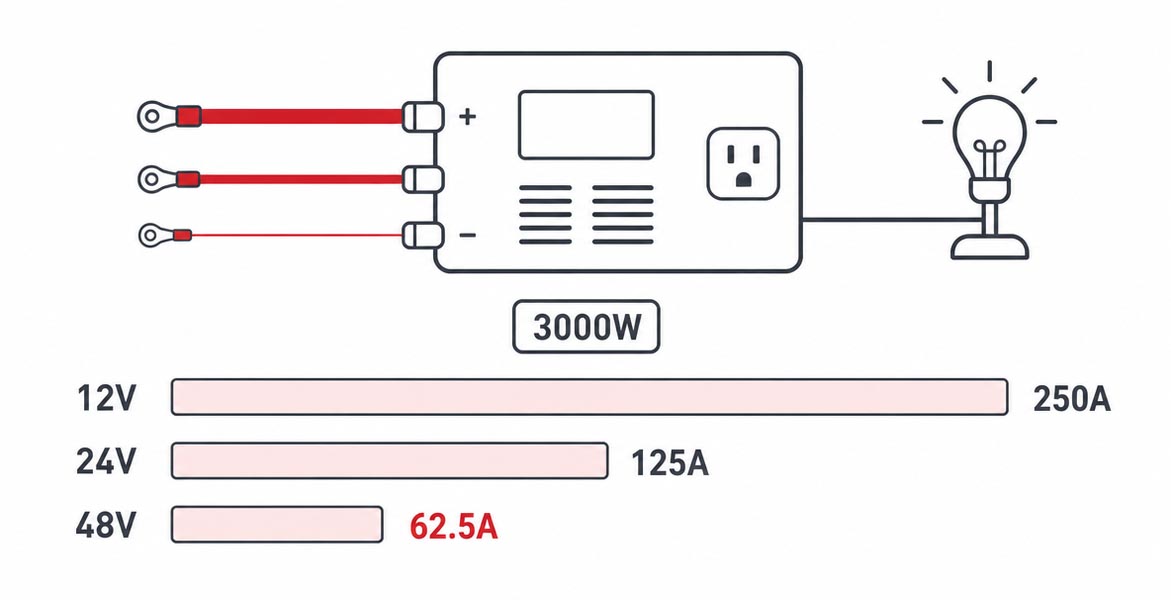
Understanding this relationship makes it much easier to see why a 3000W inverter can be very different to design around at 12V, 24V, or 48V.
The Basic Formula: Power = Voltage × Current
The basic relationship is:
Power = Voltage × Current
or:
Current = Power ÷ Voltage
For example, if we ignore inverter losses for a moment, a 3000W load would need about:
- 250A at 12V
- 125A at 24V
- 62.5A at 48V
The output power is the same, but the DC current changes greatly.
Current Comparison at Different Power Levels
| Inverter Load | 12V Current | 24V Current | 48V Current |
| 500W | 41.7A | 20.8A | 10.4A |
| 1000W | 83.3A | 41.7A | 20.8A |
| 2000W | 166.7A | 83.3A | 41.7A |
| 3000W | 250A | 125A | 62.5A |
| 5000W | 416.7A | 208.3A | 104.2A |
These are simplified theoretical values.
In a real system, battery current will usually be higher because a power inverter is not 100% efficient. Cable resistance, battery voltage changes, and operating conditions can also affect the actual current.
Still, the table shows the main idea clearly: higher DC voltage can greatly reduce current at the same power level.
When Does a 12V Power Inverter Make Sense?
12V electrical systems are very common in vehicles, RVs, vans, and smaller mobile power systems. If your batteries, chargers, and DC equipment already use 12V, staying with a 12V inverter is often the simplest choice.
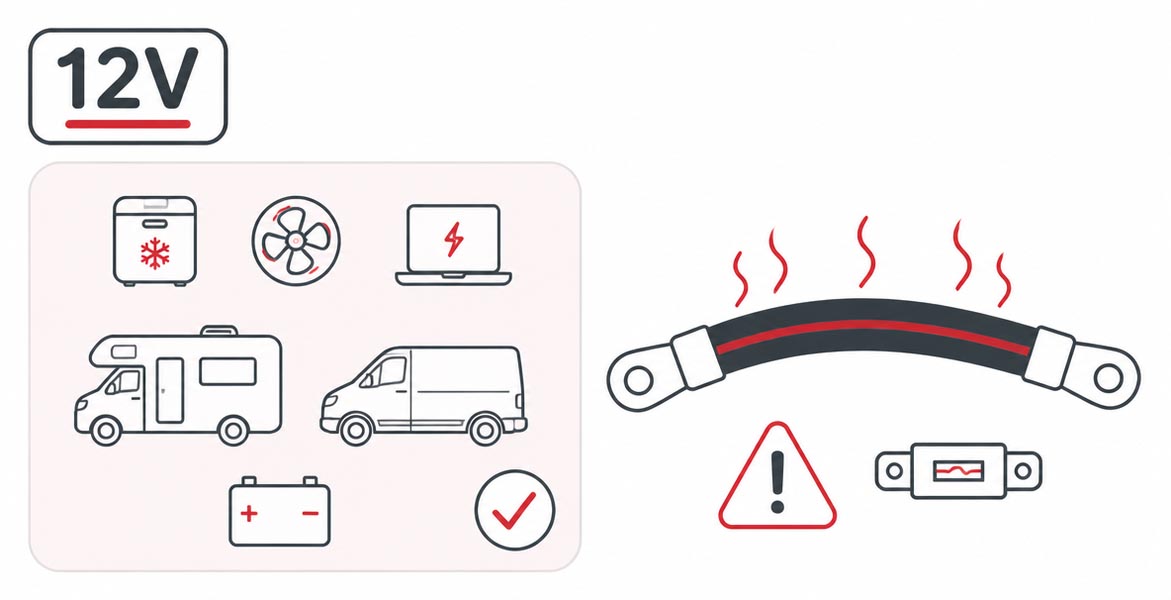
Where 12V Works Well
A 12V power inverter can be a good fit for:
- smaller RVs and campers
- vans
- light-duty vehicles
- compact mobile systems
- lower or moderate AC power demand
- systems with many existing 12V devices
One major advantage is that 12V parts and accessories are widely available.
If your system already uses 12V and the inverter is not very large, keeping the same voltage can reduce unnecessary system changes.
Where 12V Starts to Become More Difficult
As inverter power increases, a 12V system needs much more current.
For example, a 3000W load requires about 250A at 12V before inverter losses are included.
That high current affects several parts of the system:
- cable size
- cable length
- fuse selection
- connectors
- voltage drop
- heat
- battery connections
This does not mean that a 12V inverter cannot provide high power. It means the DC side becomes more demanding to design correctly.
When Should You Choose a 24V Power Inverter?
A 24V system is often a useful middle ground between 12V and 48V. It can support higher power with less current than 12V while avoiding some of the extra system changes that may come with moving to 48V.
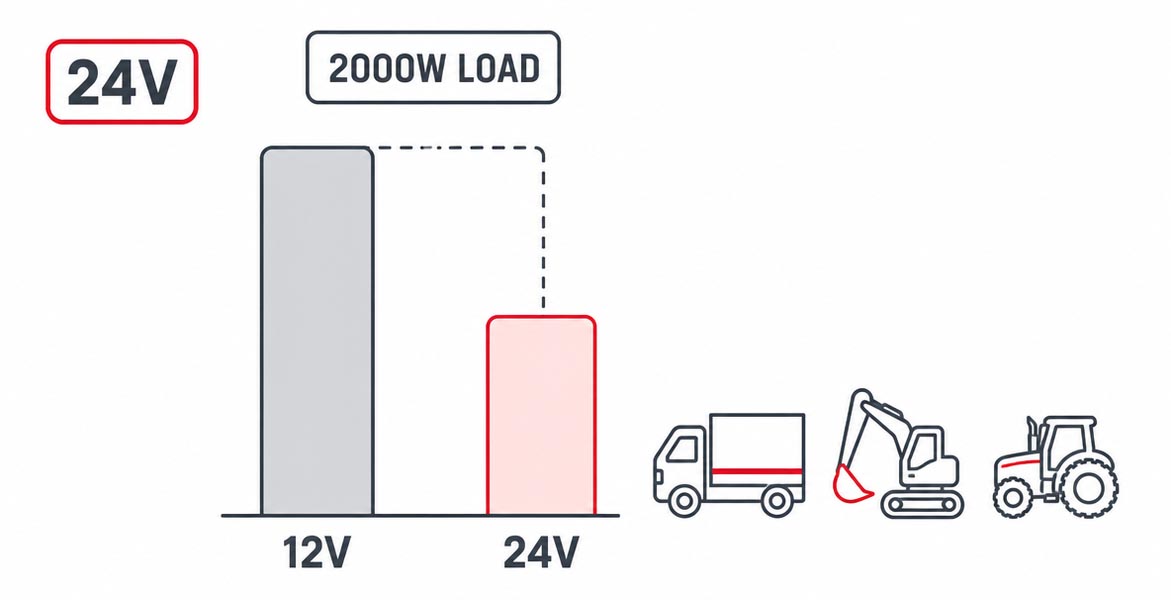
This makes 24V especially useful in vehicles and equipment that already use a 24V electrical system.
Why 24V Is a Practical Middle Ground
At the same power level, a 24V system uses about half the current of a 12V system.
For example:
A 2000W load needs about:
- 166.7A at 12V
- 83.3A at 24V
A 3000W load needs about:
- 250A at 12V
- 125A at 24V
This lower current can make cables, connectors, protection devices, and system layout easier to manage.
Applications That Often Use 24V
24V power inverters are often used in:
- trucks
- commercial vehicles
- larger RVs
- construction machinery
- agricultural equipment
- mobile equipment
- medium-power battery systems
If your machine or vehicle already uses a 24V battery system, choosing a matching 24V inverter is usually more practical than changing the whole system around the inverter.
For a real product example, DAMAVO® also offers a 24V 3kW pure sine wave inverter for higher-power vehicle and equipment systems.
When Is a 48V Power Inverter the Better Choice?
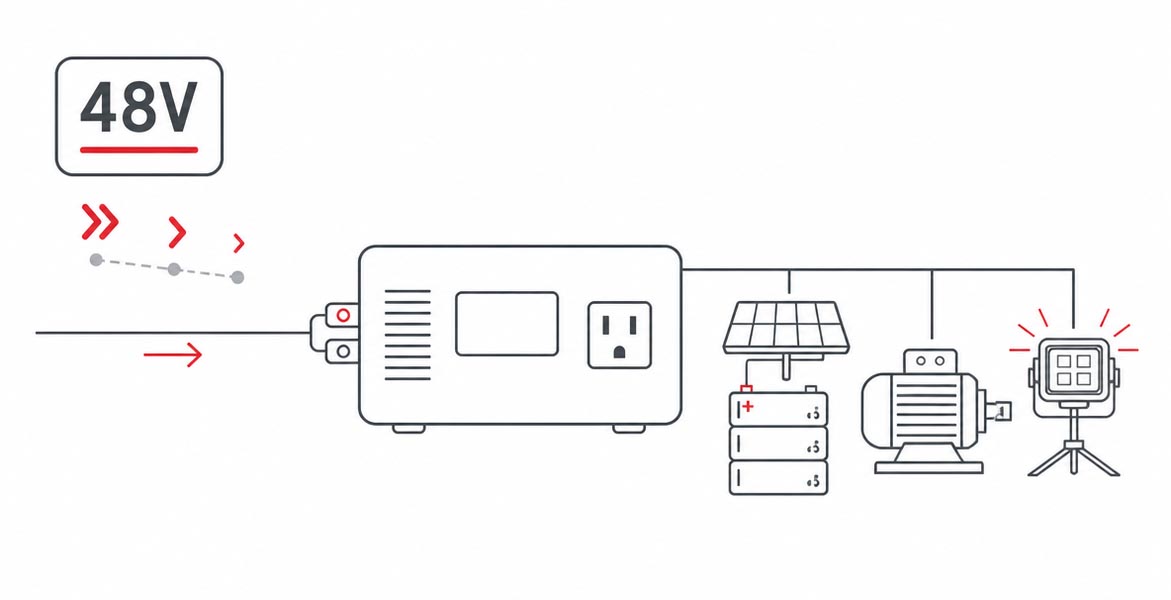
As AC power demand increases, DC current becomes a bigger part of system design. This is where a 48V system can offer a clear advantage.
The main benefit is not that 48V is automatically more advanced. The benefit is that it can deliver the same power with much lower current.
High-Power Loads Need Lower DC Current
Take a 3000W load as an example:
- 12V: about 250A
- 24V: about 125A
- 48V: about 62.5A
For a 5000W load:
- 12V: about 416.7A
- 24V: about 208.3A
- 48V: about 104.2A
At higher power, this difference becomes very important.
Lower current can make it easier to control cable loss, voltage drop, connector load, and heat on the DC side.
This is one reason 48V systems are often considered for:
- high-power mobile systems
- larger battery systems
- off-grid power systems
- high-load equipment
- higher-output inverter applications
When 48V May Be Unnecessary
A 48V system is not always the best choice.
If your vehicle already uses many 12V or 24V devices, moving the entire system to 48V may must extra components such as:
- DC-DC converters
- different chargers
- different battery arrangements
- different protection devices
- changes to existing DC equipment
For a smaller system, these extra changes may add more cost and complexity than they save.
The goal is not to choose the highest voltage available. The goal is to choose the voltage that makes sense for the complete system.
Does Higher Voltage Mean a More Efficient Inverter?
Not always.
It is important to separate inverter conversion efficiency from system-level electrical losses.
A 48V inverter is not automatically more efficient than a 12V inverter just because it uses a higher DC voltage.
The main advantage of higher voltage is lower current for the same amount of power.
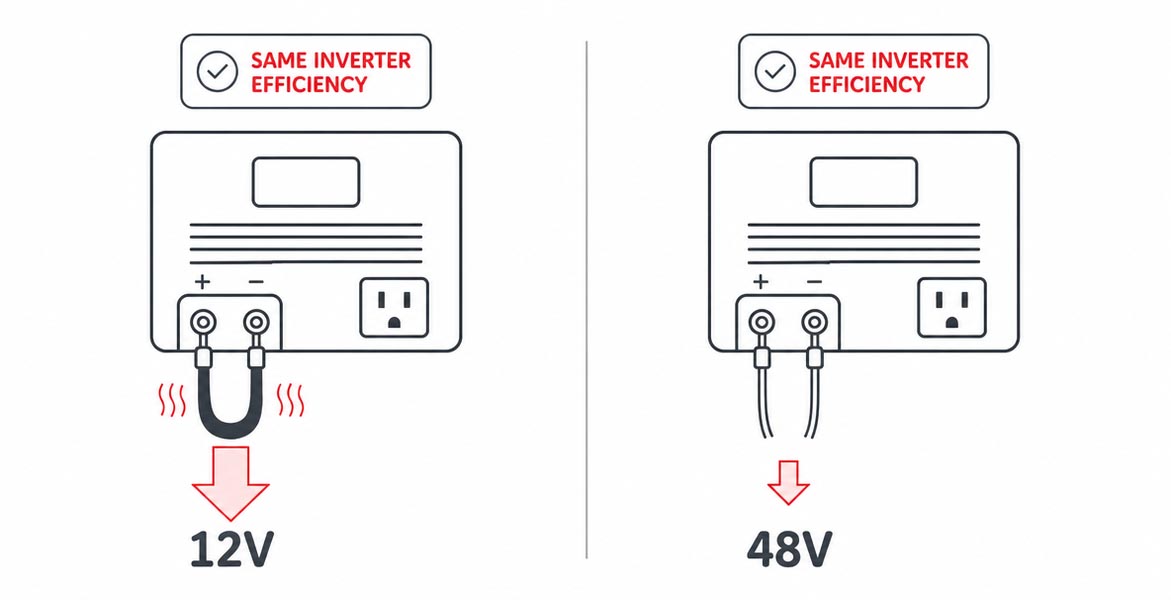
Lower current can help reduce:
- voltage drop
- cable heating
- conductor load
- connector stress
- wiring losses
So, a higher-voltage system may be easier to manage at high power, but the actual inverter efficiency still depends on the inverter design, load level, operating temperature, and other factors.
At DAMAVO®, we prefer to look at the complete electrical system instead of judging an inverter only by its input voltage.
What Size Power Inverter Do You Need Before Choosing Voltage?
Before deciding whether 12V, 24V, or 48V is the best choice, you first need to know how much AC power your system must provide.
Power demand has a direct effect on DC current, so it should be calculated before you make the final voltage decision.
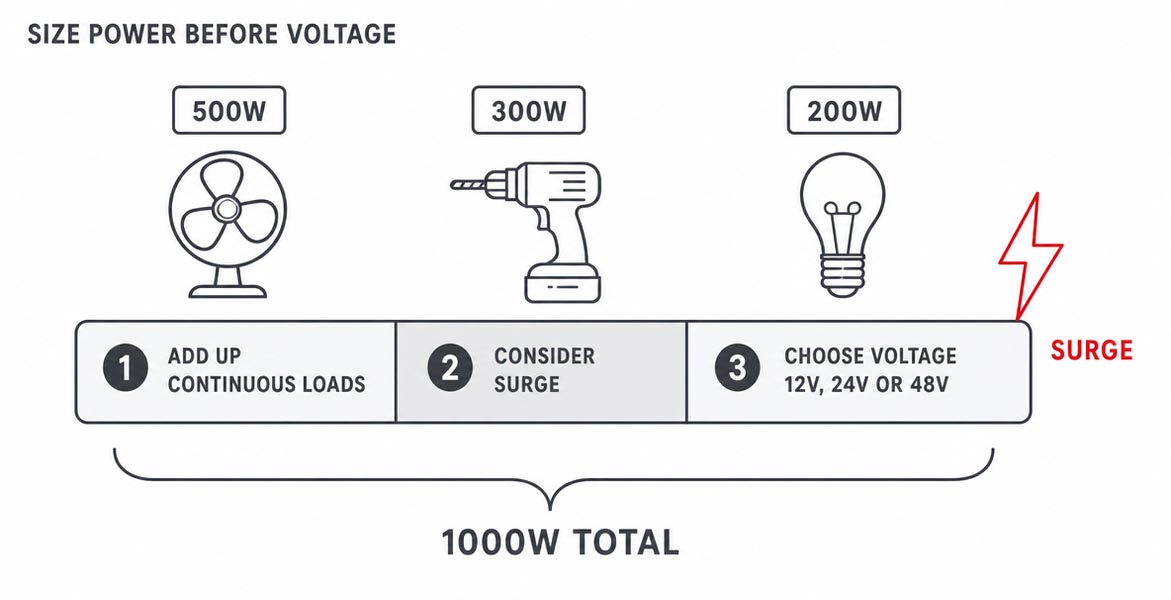
Add Your Continuous Loads
Start by listing the devices that may run at the same time.
For example:
- Device A: 500W
- Device B: 300W
- Device C: 200W
Total continuous load:
500W + 300W + 200W = 1000W
Your inverter should be able to support the combined continuous load, not just the largest single device.
Check Rated and Continuous Power
Continuous power tells you how much power the inverter can provide during normal operation.
When comparing products, make sure you understand whether the listed wattage refers to:
- continuous output
- rated output
- peak output
Do not assume that every “3000W inverter” has the same continuous and peak specifications.
Check Surge or Startup Power
Some equipment needs much more power during startup than during normal operation.
Common examples include:
- motors
- pumps
- compressors
- refrigerators
- some power tools
A system may appear to need only 1500W during normal operation but must a much higher short-term surge.
That startup demand also increases current on the DC side, making the choice between 12V, 24V, and 48V even more important in higher-power systems.
A Simple Way to Choose Between 12V, 24V, and 48V
If you are still not sure which input voltage makes the most sense, use the steps below. This method looks at the complete system instead of choosing an inverter from one number alone.
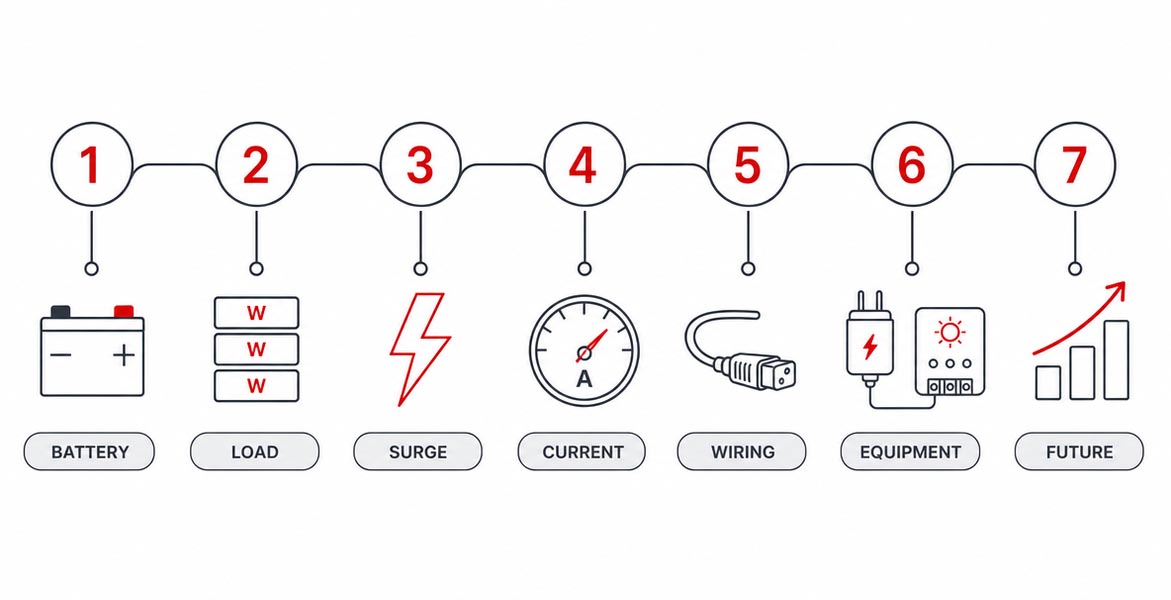
Step 1: Check Your Battery Voltage
If your vehicle or machine already has a 12V, 24V, or 48V battery system, this is usually the best place to start.
The inverter input voltage should match the system it is designed to connect to.
Step 2: Calculate Greatest Continuous Load
Add the wattage of all equipment that may operate at the same time.
This gives you the basic continuous power need.
Step 3: Check Startup Surge
Look for motors, pumps, compressors, or other loads that may need extra power when starting.
Step 4: Estimate DC Current
Use:
Current = Power ÷ Voltage
This will show you how much current the system may need at 12V, 24V, or 48V.
Step 5: Check Wiring and Cable Length
Higher current usually requires more attention to cable size, voltage drop, connectors, fuses, and heat.
Long cable runs make this even more important.
Step 6: Check Existing DC Equipment and Chargers
Make sure your:
- batteries
- alternator or charging system
- DC equipment
- solar controller
- DC-DC converters
can work with the system voltage you choose.
Step 7: Think About Future Expansion
If you expect to add larger loads later, it may make sense to plan for a system voltage that can support future power demand without creating very high DC current.
DC input voltage and output waveform solve two different questions. Voltage should match the battery system, while waveform should match the AC load. If you are still comparing waveforms, see our guide to pure sine wave vs modified sine wave inverters.
Which Inverter Voltage Fits Different Applications?
Application type can give you a useful starting point, but it should not be the only factor. Two RVs or two machines may have very different battery systems and power requirements.
| Application | Common Starting Point | Why |
| Small RV or camper | 12V | Common existing 12V system |
| Larger RV | 12V or 24V | Depends on AC power demand |
| Truck | Often 24V | Matches many truck electrical systems |
| Construction machinery | Often 24V / system dependent | Match machine electrical design |
| Agricultural machinery | 12V or 24V | Depends on equipment design |
| High-power mobile system | 48V may be practical | Lower current at high power |
| Off-grid power system | 24V or 48V | Depends on battery size and load |

Use the table below as a general guide.
These are not fixed rules.
Always check the real battery voltage, power demand, and electrical system before selecting an inverter.
Should You Change a 12V System to 24V or 48V Just for the Inverter?
Usually, the inverter alone should not decide the voltage of the entire electrical system.
Changing from 12V to 24V or 48V may affect much more than the inverter itself.
You may also need to review:
- battery configuration
- alternator or charging system
- solar charge controller
- DC appliances
- lighting
- chargers
- DC-DC converters
- cables
- fuses
- protection devices
If you are building a new system from the beginning, you have more freedom to choose the most practical voltage.
If you are adding an inverter to an existing vehicle or machine, matching the existing electrical system is often simpler.
How DAMAVO® Helps Match Inverter Voltage to Your System
Choosing the right DC input voltage becomes much easier when you look at the complete power system.
At DAMAVO®, we normally consider several points together:
- 12V, 24V, or 48V battery system
- continuous power demand
- startup or surge power
- AC output requirements
- pure sine wave or modified sine wave
- installation space
- interfaces
- protection requirements
- application environment
If you already know your battery voltage, equipment power, and main application, we can use this information to help with basic inverter matching.
If your system is still in the design stage, we can also discuss the electrical requirements before the final inverter voltage and power level are selected.
Frequently Asked Questions

Questions about 12V, 24V, and 48V inverters often come down to compatibility, current, and whether changing system voltage is really necessary. These answers can help you make a clearer first decision.
Q1: Can I use a 24V inverter with a 12V battery?
A1: Normally, no. A 24V inverter is designed to operate within a specific DC input voltage range. A single 12V battery system usually cannot provide the required input voltage. You should use an inverter designed for your battery-system voltage unless the electrical system includes a properly designed voltage conversion solution.
Q2: Is a 48V inverter better than a 12V inverter?
A2: Not always. A 48V system has a clear advantage when power demand is high because it can provide the same power with much lower DC current.
However, if your vehicle already uses a 12V system and your power demand is moderate, a 12V inverter may be simpler and more practical. The better choice depends on the complete electrical system.
Q3: How many amps does a 3000W inverter draw at 12V, 24V, and 48V?
A3: Using the basic formula and ignoring inverter losses:
- 3000W ÷ 12V = about 250A
- 3000W ÷ 24V = about 125A
- 3000W ÷ 48V = about 62.5A
Actual battery current will normally be higher because of inverter efficiency and other system losses.
Q4: Should inverter voltage match battery voltage?
A4: Yes, the inverter DC input range should match the battery system it is designed to use. Before choosing an inverter, check both the nominal battery voltage and the inverter's specified DC input range.
Q5: Does DAMAVO® offer 12V, 24V, and 48V power inverters?
A5: Yes. DAMAVO® provides power inverter solutions for different battery systems, vehicle applications, mobile equipment, and higher-power systems.
Available configurations can include different DC input voltages, output power levels, and waveform options. The best choice depends on your battery voltage, AC load, startup demand, installation conditions, and application.
Q6: Can DAMAVO® help choose the right input voltage for my equipment?
A6: Yes. If you are not sure whether your project should use 12V, 24V, or 48V, you can provide information such as:
- battery voltage
- continuous load
- startup or surge power
- AC output requirements
- application
- installation conditions
DAMAVO® can use this information to help with basic system matching and inverter selection.
Q7: Can DAMAVO® customize inverter voltage and power?
A7: Yes. DAMAVO® supports OEM and ODM inverter projects for different vehicle, equipment, and power-system applications. Depending on your project, we can discuss requirements such as:
- DC input voltage
- rated output power
- peak power
- output waveform
- AC output requirements
- interfaces
- protection functions
- product structure
- installation method
If you already have technical specifications or system requirements, sharing them can make the evaluation and product-matching process more direct.
Conclusion
There is no single best choice between 12V, 24V, and 48V.
A 12V inverter is often the simplest choice for smaller systems that already use 12V. A 24V inverter can offer a useful balance between power and DC current. A 48V inverter becomes especially useful when higher power makes DC current difficult to manage.
The best DC input voltage is the one that fits the complete power system, not simply the highest voltage available.
Before making your final choice, check your battery voltage, greatest continuous load, startup surge, DC current, wiring, and future power needs. Once these points are clear, choosing the right power inverter becomes much easier.
Power Inverter Manufacturer Guide: How OEM Buyers Should Evaluate an Inverter Supplier
What Can a Modified Sine Wave Power Inverter Run? A Load Matching Guide
Related Article