Power Inverter Manufacturer Guide: How OEM Buyers Should Evaluate an Inverter Supplier
Choosing a power inverter manufacturer is not only about comparing prices or product catalogs. For OEM buyers, the right supplier should also have reliable engineering, manufacturing, quality control, customization, and long-term technical support.
A good sample does not always mean a supplier can deliver stable mass production. Before choosing a supplier, OEM buyers should evaluate the complete process from product requirements and engineering to validation, production, quality control, and future support.

Quick Answer: How Should OEM Buyers Evaluate a Power Inverter Manufacturer?
A reliable power inverter manufacturer should be evaluated based on eight key areas:
- Engineering and R&D capability
- In-house manufacturing control
- OEM and customization capability
- Sample and product validation
- Quality control and testing
- Documentation and compliance
- MOQ, lead time, and delivery
- Long-term technical support
Price and product range are important, but they should not be the only criteria when selecting an OEM power inverter supplier.
1. Start With Your Project Requirements
Before comparing power inverter manufacturers, define your own project requirements.
Simply asking for a “3000W inverter” is usually not enough. The supplier needs to understand the application, electrical requirements, quantity, and target market.
If you are still defining the right configuration for your project, you can first review DAMAVO® power inverter options by input voltage, output power, and application.

Define the Application
Common applications include:
- RVs and campers
- Vehicles
- Marine systems
- Off-grid systems
- Industrial equipment
- Other electrical equipment
Different applications may require different input voltages, output configurations, mounting methods, protection functions, connectors, and environmental requirements.
Prepare the Electrical Requirements
At minimum, provide:
- DC input voltage
- AC output voltage
- Rated power
- Surge power
- Output frequency
- Load type
Define the Business Requirements
OEM buyers should also consider:
- Estimated order quantity
- Annual demand
- Target market
- Certification requirements
- Target launch date
- Branding requirements
- Packaging requirements
A clear project brief allows different manufacturers to evaluate the same requirements and makes quotations easier to compare.
2. Verify the Supplier's Manufacturing Capability
A company selling power inverters is not necessarily a complete power inverter manufacturer.
For an OEM project, buyers should understand where the product is designed, manufactured, assembled, and tested, and who is responsible when technical or quality problems occur.

Check What Is Done In-House
Ask the supplier:
- Where is the R&D team located?
- Who designs the PCB?
- Where is PCBA produced?
- Where is final assembly completed?
- Who performs product testing?
- How is quality controlled?
Important manufacturing processes may include:
- Component sourcing
- BOM control
- SMT
- PCBA testing
- Product assembly
- Functional testing
- Aging testing
- Final inspection
The goal is not simply to confirm that a supplier has a factory. The more important question is how much control the manufacturer has over the processes that affect product quality and consistency.
You can also review DAMAVO® as a power inverter manufacturer to see how engineering, manufacturing, testing, and quality control are integrated within one production system.
3. Evaluate Engineering and OEM Customization Capability
For OEM projects, engineering capability can be as important as production capacity.
A capable power inverter manufacturer should be able to understand customer requirements, modify products when needed, develop prototypes, and solve technical problems during validation.
Key Engineering Capabilities
Depending on the project, check whether the supplier has:
- Electrical engineering
- PCB design
- Firmware development
- Thermal design
- Mechanical design
You should also ask who will solve technical problems such as EMI issues, overheating, communication errors, startup problems, or connector compatibility.
Understand the OEM Customization Level
Not every supplier means the same thing when it says “OEM/ODM available.”

Level 1: Branding Customization
- Logo
- Label
- Packaging
- User manual
Level 2: Configuration Customization
- DC input
- AC output
- Socket
- Connector
- Cable
- Display
Level 3: Engineering Modification
- PCB changes
- New functions
- Communication interfaces
- Housing changes
- Thermal design changes
Level 4: Full Custom Development
Requirement → Design → Prototype → Validation → Production
More advanced projects require stronger engineering and project management capabilities.
For projects that require more than basic branding, DAMAVO® provides OEM and ODM manufacturing support from product development and PCB design to prototyping, testing, and mass production.
When Do You Need a Custom Power Inverter?
A custom power inverter manufacturer may be the better choice when your project requires:
- A special DC input range
- A specific AC output
- Custom housing
- Special mounting
- CAN or RS485 communication
- Brand-specific connectors
- Application-specific protection
- Integration with another control system
The key question is not only whether the supplier can make the requested change, but whether the modified product can be properly validated and produced consistently.
4. Validate the Product Before Mass Production
Do not approve a power inverter manufacturer based only on one good sample.
A sample proves that one unit works. It does not prove that hundreds or thousands of units will have the same performance.

Check the Engineering Sample
Depending on the application, evaluate:
- Basic functions
- Electrical performance
- Mechanical fit
- Load compatibility
- Communication
- Thermal performance
- Protection functions
Consider Pilot Production
For larger OEM projects, a pilot production run can provide additional information about manufacturing stability.
A typical process is:
Engineering Sample → Pilot Production → Mass Production
Pilot production can help verify:
- Production processes
- SOPs
- Material consistency
- Production fixtures
- Testing procedures
- Product consistency
Lock the Approved Version
Before mass production, confirm the approved:
- Sample
- BOM
- PCB revision
- Firmware version
- Product drawing
- Label
- Packaging
This reduces the risk of differences between the approved sample and production units.
5. Compare MOQ, Lead Time, and Total Project Cost
Price is important, but the lowest unit price does not always mean the lowest total project cost.

Understand MOQ
MOQ may vary depending on the project:
- Standard product MOQ
- Logo customization MOQ
- Packaging MOQ
- Housing customization MOQ
- Electrical customization MOQ
If a supplier quotes a specific MOQ, confirm which customization level that number applies to.
Confirm Lead Time
Ask what the quoted lead time includes:
- Engineering
- Tooling
- Prototype
- Certification
- Production
- Shipping
For new OEM projects, development time and production lead time should be considered separately.
Check Engineering Change Control
Component or design changes may involve:
- MOSFETs
- Capacitors
- MCU
- Connectors
- PCB revisions
OEM buyers should ask:
Will the supplier notify us before making an engineering change, and does the new version need to be validated again?
A clear change-control process can reduce production and quality risks.
6. Check Documentation, Compliance, and Traceability
Technical and compliance documents should be confirmed before mass production, not only before shipment.
 Product Documentation
Depending on the project, useful documents may include:
- Datasheet
- Product drawing
- User manual
- Test specification
- Packaging specification
- Other technical documents
Market Compliance
Confirm:
- Exact product model
- Input and output configuration
- Target market
- Applicable certification
- Whether additional certification is required
Do not assume that certification for one inverter model automatically covers another model or configuration.
Quality Records
For OEM projects, buyers may also request:
- Inspection records
- Functional test records
- Aging records
- Traceability information
These records can help verify that production quality is controlled consistently.
7. Evaluate Long-Term Supplier Performance
Supplier evaluation should continue after the first order.
For long-term OEM cooperation, review three areas.

Delivery Performance
- On-time delivery
- Quantity accuracy
- Packaging accuracy
- Documentation completeness
Quality Response
When a quality issue occurs, the supplier should be able to:
- Identify the root cause
- Contain the problem
- Provide corrective action
- Prevent recurrence
For formal quality issues, an 8D report may be required.
Future Engineering Support
OEM requirements may change after product launch.
Future support may include:
- Cost reduction
- New power levels
- Connector changes
- Firmware updates
- New market versions
- Product upgrades
A long-term power inverter manufacturer should be able to support the product beyond the first purchase order.
8. Use a Power Inverter Supplier Scorecard
A supplier scorecard can make OEM supplier evaluation more objective.
| Supplier Area | Suggested Weight | Key Evaluation Points |
| Engineering | 20% | R&D and technical problem solving |
| OEM Capability | 15% | Customization and development |
| Manufacturing | 15% | In-house processes and capacity |
| Quality System | 15% | QC, traceability, corrective action |
| Testing | 10% | Functional, load, and aging tests |
| Documentation | 10% | Technical and compliance documents |
| Delivery | 10% | MOQ, lead time, and capacity |
| Technical Support | 5% | Engineering and after-sales response |

You can adjust the weighting according to the requirements and risk level of your project.
9. 14 Questions to Ask a Power Inverter Manufacturer
Before approving a supplier, ask:
- Which inverter manufacturing processes are completed in-house?
- What engineering capabilities do you have?
- What level of OEM or ODM customization do you support?
- Can you modify an existing inverter design?
- How do you validate engineering samples?
- Do you support pilot production?
- How do you control BOM and design revisions?
- What functional and aging tests do you perform?
- What is the MOQ for my customization level?
- What is included in the quoted lead time?
- What technical and quality documents can you provide?
- How do you manage engineering changes?
- How do you handle quality problems after shipment?
- Can you support future product upgrades?
These questions can help buyers compare manufacturers based on actual capabilities instead of price alone.
10. Why Choose DAMAVO® for OEM Power Inverter Projects?
DAMAVO® supports power and electrical projects for vehicles, RVs, marine applications, and other equipment.
For OEM customers, the project may involve more than supplying an existing inverter. Depending on the application, DAMAVO® can support different stages of the product lifecycle, including:

OEM projects may involve product configuration, electrical and mechanical customization, PCBA development, sample validation, and mass-production support.
The exact development path depends on the application, technical requirements, target market, and order volume.
11. Frequently Asked Questions

Q1: How Do I Find a Reliable Power Inverter Manufacturer?
A1: Do not compare only product range and price. Review engineering capability, manufacturing processes, quality control, testing, OEM support, delivery performance, documentation, and long-term technical support.
Q2: What Is the Difference Between a Power Inverter Manufacturer and a Supplier?
A2: A manufacturer directly manages part of the product design or manufacturing process. A supplier may mainly sell products or manage sourcing without manufacturing the product itself.
For OEM projects, confirm who is responsible for engineering, manufacturing, testing, and quality problems.
Q3: What Information Should I Send for an OEM Power Inverter Project?
A3: Provide:
- Application
- DC input
- AC output
- Power requirement
- Load type
- Estimated quantity
- Target market
- Certification requirements
Drawings, samples, schematics, BOMs, or other technical information can help the manufacturer understand the project faster.
Q4: What Can a Custom Power Inverter Manufacturer Change?
A4: Depending on the supplier's capabilities, customization may include branding, input and output configurations, connectors, housing, communication functions, PCB design, firmware, and full product development.
Q5: Should I Order a Sample Before a Bulk Inverter Order?
A5: Yes. A sample is an important part of the approval process. For larger OEM projects, pilot production can provide additional information about manufacturing consistency before full-scale production.
Q6: What Certifications Should I Ask an Inverter Supplier For?
A6: Certification requirements depend on the target market and exact product configuration. Confirm whether the certification applies to the specific model, voltage, and configuration you plan to purchase.
Conclusion
Choosing a power inverter manufacturer is more than comparing unit prices.
For OEM buyers, the right supplier should be able to support the product from requirements and engineering to sample validation, pilot production, mass production, quality control, and future upgrades.
A practical supplier evaluation process is:
Requirements → Engineering → Sample → Validation → Pilot Production → Mass Production → Support
By evaluating these areas before placing a large order, OEM buyers can reduce development risk and build a more reliable long-term supply relationship.
If you are looking for an OEM or custom power inverter manufacturer, share your application, input and output requirements, power level, expected quantity, target market, and customization needs with DAMAVO®. This information can help determine the most suitable development and production approach for your project.
How to Choose a Automotive Wireless Charger : Vehicle Fit, Input Voltage and Installation
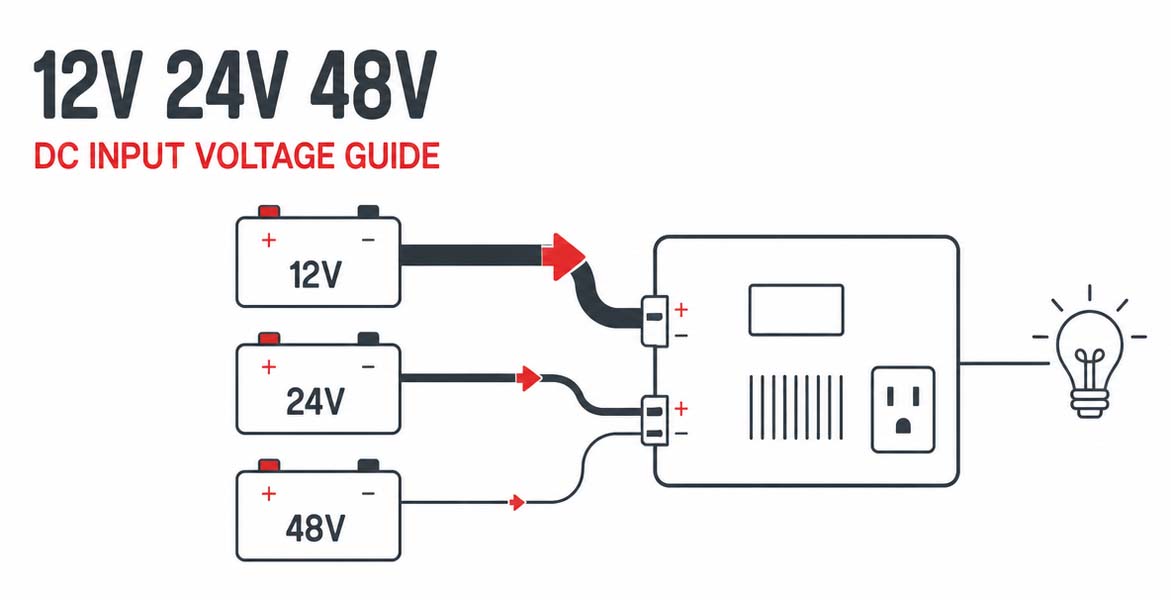
12V vs 24V vs 48V Power Inverter: How to Choose the Right DC Input Voltage
Related Article